















Following the birth of my daughter, I experienced a moment many mothers fear but rarely discuss: a total loss of bladder control while simply walking across my living room. It wasn’t a minor leak triggered by a cough or a laugh; it was a complete “clocking out” of my pelvic floor without any warning. Despite having my first child six years prior and managing the typical “cross-your-legs-to-sneeze” symptoms, this was a new, unsettling level of postpartum reality. Even fourteen years later, like many women, I still found myself planning my life around bathroom breaks and bracing for every sudden movement.
In fitness communities, particularly high-impact environments like trampoline classes, “peeing yourself” is often treated as a humorous rite of passage. Women swap stories about period underwear and mid-workout bathroom breaks as if they are inevitable consequences of motherhood. While this camaraderie is supportive, experts argue that normalizing the discomfort of urinary incontinence prevents women from seeking real solutions.
Statistics show that one in three women deal with bladder leaks within their first year postpartum, a figure that rises to 50% as women approach menopause. Despite these high numbers, many healthcare providers fail to screen for it. Lauren Barker, CEO of Uresta, emphasizes that while incontinence isn’t life-threatening, it is a significant quality-of-life issue. Many women spend decades managing leaks with pads or restrictive habits, unaware that they shouldn’t have to “just deal with it.”
While options like pelvic floor physical therapy are highly effective, they are often under-prescribed in North America. Prescription pessaries exist as well, but their invasive fitting processes and low retention rates—estimated at just 16%—often leave women looking for a better alternative.
An Innovative Approach to Bladder Leak Prevention
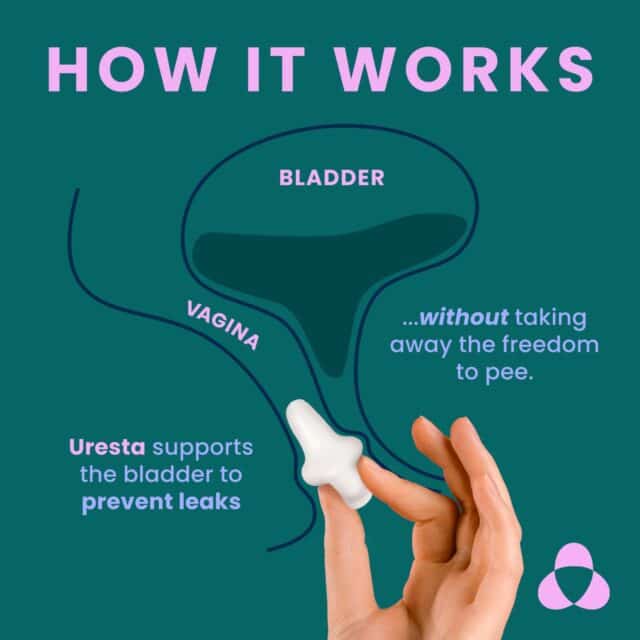
Uresta offers a modern alternative as the first FDA-approved, over-the-counter bladder support device that can be fitted at home. Think of it as a “bra for your bladder.” Unlike a plug, this bell-shaped device is inserted vaginally to sit just beneath the urethra. It provides the necessary counter-pressure to keep the urethra closed during sudden pressure spikes—like jumping or sneezing—without blocking the natural flow of urine when you actually need to go.
The device is crafted from firm, medical-grade, non-absorbent resin. To ensure a proper fit, the starter kit includes three common sizes that accommodate roughly 90% of users. The goal is to find a size that stops the leaks while remaining comfortable and allowing for normal urination. For many, the sensation is similar to using a menstrual cup; once positioned correctly past the pubic bone, it becomes virtually unnoticeable.
In real-world testing—including high-intensity trampoline workouts—the device proves its worth. It stays in place through twisting and jumping, providing a level of security that pads cannot match. It can be worn for several hours at a time, including overnight, and is easily removed and cleaned for reuse.
One of the most profound realizations for users is discovering how much they were subconsciously limiting themselves. Whether it’s skipping specific exercises, avoiding certain clothing colors, or mapping out every public restroom, bladder leaks create a mental load. By removing that obstacle, women can reclaim activities they once enjoyed without the “cost of doing business” being an embarrassing accident.
Uresta is available as a $65 starter kit, which is HSA and FSA eligible. It offers a sustainable, reusable solution that empowers women to take control of their pelvic health on their own terms.
Essential Facts About Using Uresta for Bladder Control
Is Uresta an FDA-approved device?
Yes. Uresta holds the distinction of being the only reusable, over-the-counter bladder support device with FDA approval currently available in the U.S. market. It provides a non-prescription option for women who want immediate support without waiting for a specialist appointment.
What is the cost and maintenance of the device?
The initial starter kit costs $65 and includes the three most common sizes. Each device is designed for long-term use, though it is recommended to replace the device annually. Because it is a medical product, it is eligible for reimbursement through most Health Savings Accounts (HSA) and Flexible Spending Accounts (FSA).
Can I use this during the postpartum period?
Absolutely. Postpartum recovery is one of the primary reasons women seek out Uresta. It is important to note that your size requirements may shift as your body heals or as hormonal levels change (such as during breastfeeding, when lower estrogen levels can affect tissue elasticity). The company offers a free size exchange within the first 30 days to ensure you have the correct fit as your body transitions.
Final Thoughts
Urinary incontinence is a common experience in motherhood and aging, but it doesn’t have to be a permanent lifestyle restriction. By moving beyond the “normalization” of bladder leaks and utilizing accessible, medical-grade support like Uresta, women can return to the workouts and activities they love with confidence. Whether you are two days postpartum or decades into motherhood, your quality of life matters, and there are tools available to help you feel like yourself again.